80% of cost is decided before the product exists.
A 50-page chapter by Davila and Wouters on management accounting in manufacturing. The 4–5 ideas that stuck with me.
Davila and Wouters lay out the academic literature on how manufacturing firms manage costs across two phases of a product's lifecycle: during product development (New Product Development) and during actual production (Modern Manufacturing Systems). The chapter runs fifty pages, dense with citations and cross-references — here I share the passages that made me pause.
1. The 80% reveal
Cooper & Slagmulder (1999), cited by the authors, argue that 80% of a product's costs are decided during the development phase, not during production. By the time a product hits the assembly line, the game is over: every component, every tolerance, every material has been chosen at the design stage. Companies that want to reduce costs must do so before the product physically exists.
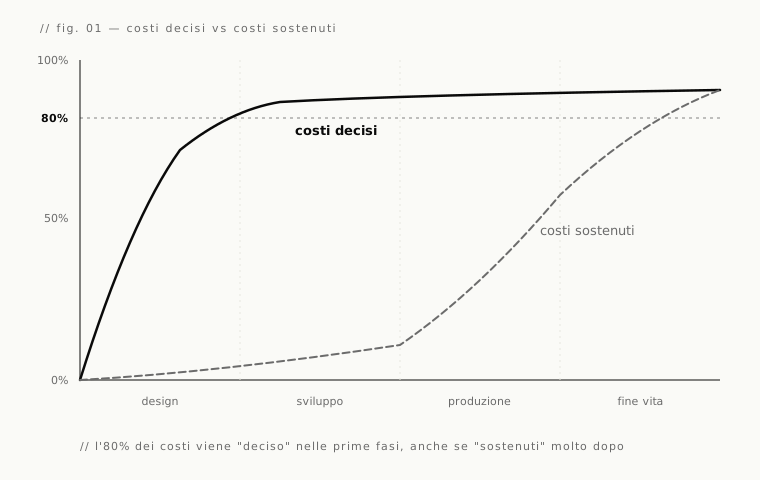
It's a sharp shift in perspective: a feasibility study isn't "calculating expected costs", it's "deciding which costs to have". Two different activities, with different responsibilities.
2. Target costing — and when it falls short
Target costing is the most studied technique for managing costs during design. It works like this: start from the market price the product will sell at, subtract the required margin, and arrive at a target cost. The development team has to stay within that budget, redesigning if needed. It's a rigorous discipline, and it works well when price is the main competitive dimension (commodities, economy cars, consumer electronics).
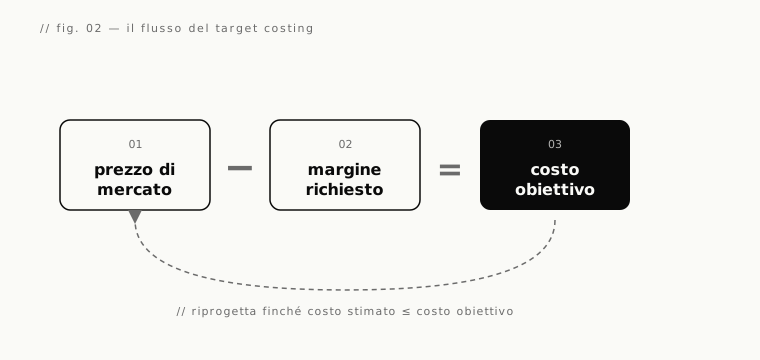
But if competition is played on technology, time-to-market or customization, target costing loses effectiveness. Davila & Wouters list alternatives:
- Cost specialists embedded in development teams (Hertenstein & Platt, 2000).
- Parallel teams that optimize sub-systems after the main design is done.
- Modularity: designing non-critical sub-systems as reusable "black boxes" (Baldwin & Clark, 2000).
- Design for X (Manufacturing, Assembly, Recycling, Serviceability): heuristics meant to reduce downstream costs.
- Parts and process commonality: reducing complexity by sharing components and processes across products.
3. Measuring R&D is still an unsolved problem
What hit me most: even in 2007 — and I suspect today too — there's no consensus on how to measure R&D performance. Hertenstein & Platt (2000) report that managers give 4.9 out of 10 to the current quality of their measurement systems, against a desired 7.2. There's an openly acknowledged gap between what people want to measure and what they manage to.
Financial metrics get used (IRR, ROI, percentage of revenue from new products, R&D effectiveness index), non-financial ones too (time-to-market, process quality, customer reaction to prototypes), at various levels of aggregation: single project, project portfolio, R&D function, the whole organization. Real options have been proposed to value high-risk investments. But the point stands: no single metric really works on its own.
R&D departments doing external work use more objective measures. — Drongelen et al. (1999), cited in the chapter
4. Modern manufacturing: the problem of intangible benefits
When a firm invests in modern production technologies — robotics, MRP, flexible systems, computer-integrated manufacturing — the benefits are often intangible: higher quality, faster delivery times, customization capacity, volume flexibility. Translating these into financial numbers to justify the investment is hard, and the risk is that strategically sound projects get rejected by traditional financial analysis.
Empirical evidence collected in the chapter shows that most firms try to quantify intangible benefits inside the financial analysis anyway — even with rough approximations — rather than excluding them entirely. Abdel-Kader & Dugdale (1998) show that seven typical MMS benefits do get turned into numbers: reduced labor costs, material costs, inventory, scrap, increased sales volume, setup savings, increased production capacity.
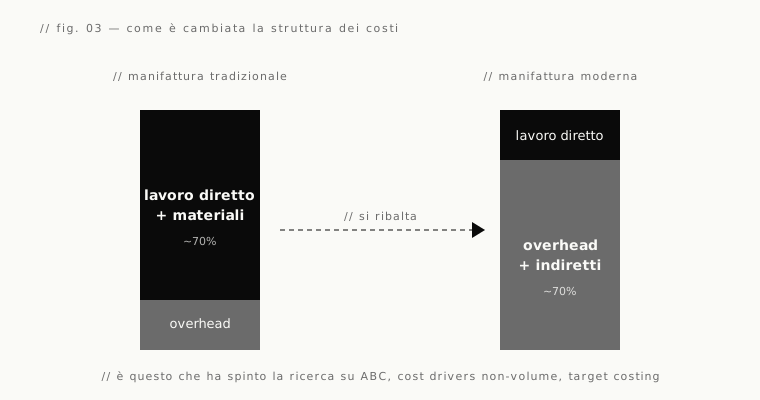
Payback period and IRR remain the most-used criteria in practice, even if financial theory would prefer NPV. And there's an interesting piece of evidence: firms don't always raise the discount rate to reflect the higher risk of MMS — which contradicts what corporate finance would suggest.
5. What I take away
Three things:
- Design is where costs are made, not production. It changes where you put your attention, and it changes who is responsible for what.
- Measurement is an open problem, not an exact science. Feeling unsure when looking at metrics is justified — even researchers are, and they say so openly.
- Companies invent workarounds. In the field, when theory says "X" but reality is complex, companies combine techniques (target costing + ABC + value engineering + DFX). Nothing is "pure" in practice, and that's exactly where the interesting work is.
The fact that much of the research cited is 15+ years old and the fundamental questions remain open is actually reassuring: there's still room for those who want to enter these topics without having to be the definitive expert before they even start.