Big companies fail because they do everything right.
Clayton Christensen, 1997. The book that gave a name to "disruption" and explained why market leaders are routinely wiped out by smaller newcomers.
The Innovator's Dilemma is the book that turned "disruption" from startup slang into an analytical category. Christensen published it in 1997, starting from a seemingly absurd observation: the world's best-managed companies — those that listen to customers, invest in R&D, watch their financials — fail precisely because they do everything right.
1. The paradox
Christensen studies technology industries (hard drives, excavators, steel) and notices a recurring pattern: in every sector, every 10–15 years, the market leader gets replaced by a newcomer that initially looked ridiculous. Not because of incumbent incompetence — but because of correct managerial logic that becomes wrong when a certain type of innovation arrives.
2. Sustaining vs disruptive
The key is distinguishing two types of innovation:
- Sustaining innovation: improves the product on the dimensions current customers already value. Faster, more reliable, higher capacity. Big companies are excellent at this — it's their day job.
- Disruptive innovation: starts out worse than the incumbent product on metrics that matter to mainstream customers. But it's cheaper, simpler, accessible to customers who couldn't afford that category. It begins in a niche or low-end market.
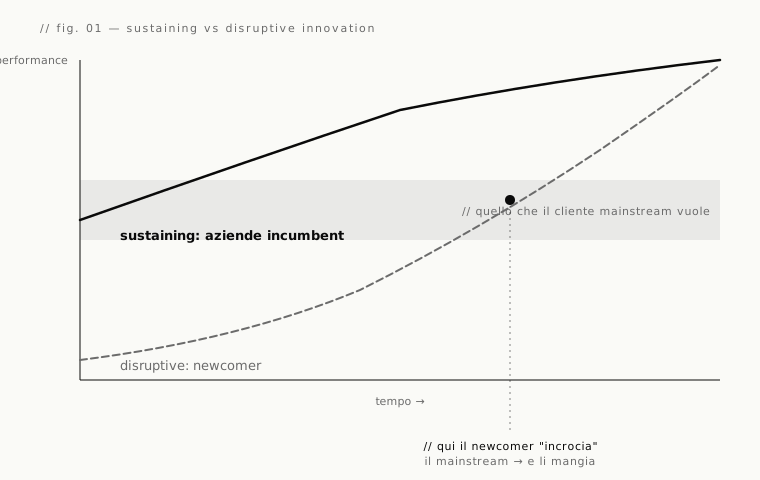
The classic example is the hard disk drive: every generation (14" → 8" → 5.25" → 3.5" → 2.5") was born with too little capacity for the incumbent's enterprise customers, but improved fast enough to displace them within a decade. The same pattern applies to steel mini-mills vs integrated steel, hydraulic vs mechanical excavators, Netflix vs Blockbuster, Wikipedia vs Encarta.
3. Why incumbents lose (and it's not stupidity)
The book's brilliant insight is the structural explanation of failure. The incumbent doesn't lose because of incompetence — it loses because it's doing exactly what management textbooks teach:

- It listens to its best customers → they want "more of what they already have", not inferior stuff.
- It looks at margins → disruptive tech has thin margins, not interesting.
- It invests where the revenue is → a new $50M market is irrelevant next to a $5B one.
- It has a cost structure optimized for its scale → it can't compete on price in the low segment.
When the newcomer "scales up" and reaches mainstream, the incumbent has the wrong organizational structure to chase it. Factories, sales force, channel partners, development processes — all tuned to a different kind of product.
4. What I take away
Three things:
- Past success is a debt, not an asset, in the face of disruption. The better you are at what you do, the more rigid you are at changing. They call this the "core competence trap".
- Not all novelty is disruption. Many "innovations" are sustaining in disguise — they improve the existing product. True disruption starts below on some dimension, and initially looks like a regression.
- The book is 28 years old and still describes the present well. That's been an important test for me: frameworks that survive time are few and deserve respect.
One final note: Christensen has been (rightly) criticized for applying "disruption" to cases that don't fit the strict model. But the strict 1997 model — disruption as a bottom-up phenomenon in low-margin tech markets — is still one of the most useful lenses for understanding why an apparently solid company can vanish in 5 years.