AI isn't good "in general". It's great here, and bad there.
Dell'Acqua, Mollick, Lakhani and colleagues, 2023. The experiment with 758 consultants that showed two things at once: AI makes quality soar — and makes people wrong with more confidence, as soon as the task leaves its territory.
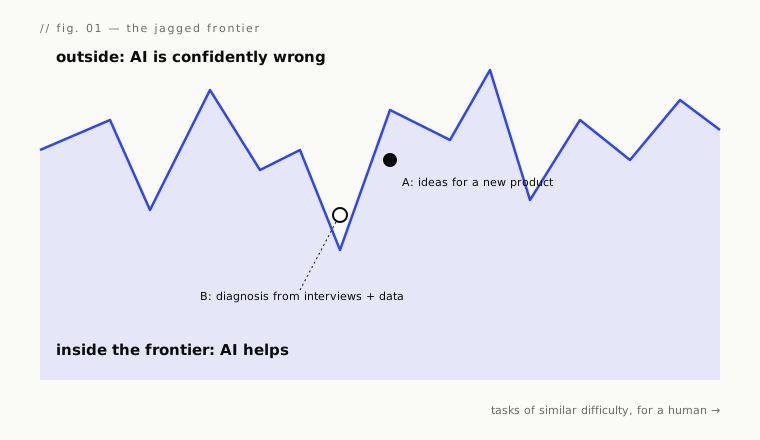
One question comes back in every discussion about AI at work: "so, is it good or not?". This study gives the most useful possible answer: it depends on the task, and the boundary isn't visible to the naked eye. The authors call it the jagged technological frontier.
1. The experiment
Researchers from Harvard, Wharton, MIT and Warwick worked with Boston Consulting Group on 758 consultants, about 7% of the firm's individual-contributor consultants. Each was randomly assigned to one of three conditions: no AI, GPT-4, or GPT-4 plus a short prompting overview.
The tasks weren't lab exercises: they were designed to resemble real consulting work. And they came in two kinds, chosen on purpose — some inside the model's capabilities, one just outside.
2. Inside the frontier: everything improves
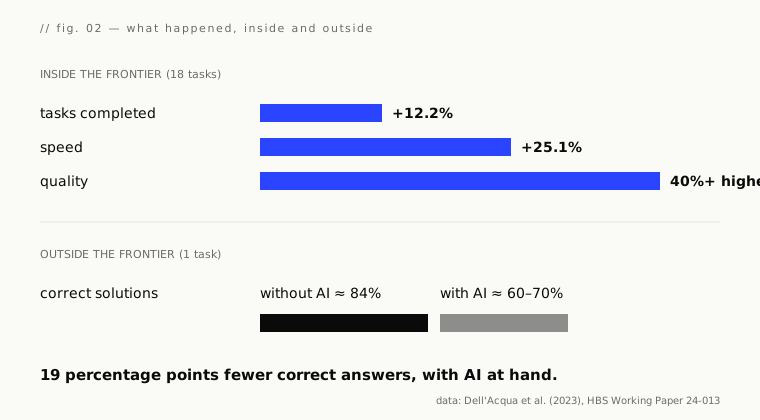
On 18 tasks of a creative and analytical kind — imagining a new product for a niche market, segmenting it, drafting the launch, summarising — people using AI completed on average 12.2% more tasks, 25.1% faster, with over 40% higher quality than the control group.
The most interesting detail is who benefited: below-average consultants improved by 43%, above-average ones by 17%. AI acted as a leveller: it raised the floor much more than the ceiling. There's a flip side too: ideas produced with AI were better but more similar to each other. Higher average quality, less variety.
3. Just outside: AI is wrong, and convincing
The "outside the frontier" task was a business case: working out, from interview notes and a spreadsheet, which brand a company should invest in. The trap was subtle: the numbers alone pointed one way, but a detail in the interviews flipped it. A good analyst spots it; the model, at the time, didn't.
Result: without AI about 84% of consultants reached the correct solution; with AI it fell to 60–70%. On average, 19 percentage points fewer. Not because AI refused the task, but because it produced a plausible, well-written and wrong answer — and many accepted it.
4. Centaurs and cyborgs
Looking at how the best consultants worked, the authors spotted two styles:
- Centaurs split the work cleanly. I do this part, I hand that one to the AI — like the centaur, half human and half horse, with a clear line between.
- Cyborgs keep interweaving their work with the model's, sentence by sentence, correcting and relaunching.
Both work. What doesn't work is the third, unspoken style: delegating everything and trusting it.
5. What I take away
- "Good" isn't a property of AI, it's a property of the task. The right question isn't whether to use it, but where the frontier lies for the work I'm doing.
- The frontier moves, and fast: the study used GPT-4 in 2023. The point isn't the exact number, it's that the boundary always exists somewhere — and has to be found again each time.
- The real risk is trust, not error. A mistake that looks right is more dangerous than an obvious one. You need people who can spot the details the model misses.
It struck me because I saw it up close in my thesis: in a real case AI was useful to search for reference items starting from the rules I had written, but the calculation stayed with the rules and the checking with people. Without knowing it, it was a centaur way of staying inside the frontier.