When prediction becomes nearly free, everything is redesigned.
Agrawal, Gans and Goldfarb, 2022. AI as a "prediction machine" — and what happens to an industry when one of its key inputs goes from expensive to nearly free.
Agrawal, Gans and Goldfarb are three economists at the Rotman School in Toronto. In 2018 they wrote Prediction Machines, proposing the idea that AI is literally "a technology that lowers the cost of prediction". Power and Prediction (2022) is the sequel that asks: if that cost really collapses, what happens to business and organizations?
1. AI = prediction (at low cost)
The book's definition is precise: modern AI is a system that, given inputs, produces probabilistic estimates about something you don't know. It's prediction. It's not "intelligence", not "reasoning" — it's completing missing data. Machine translation predicts the next word, computer vision predicts what's in an image, a Netflix recommendation predicts what you'll watch.
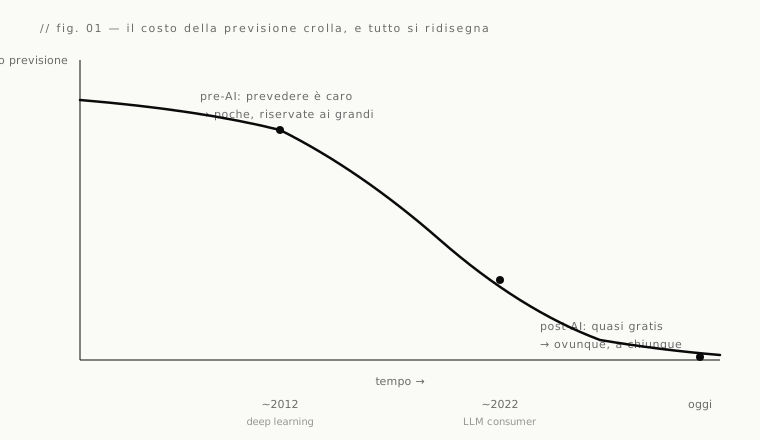
A decision, the authors say, decomposes into: prediction ("what will happen?") + judgment ("given what will happen, what do I decide?"). AI handles the first part; judgment stays human. The more prediction becomes abundant, the more the real bottleneck becomes judgment — what's worth doing and what isn't.
2. The three levels of impact
Here's the strategic core of the book. When a resource becomes cheaper, impact spreads across three levels, in crescendo:
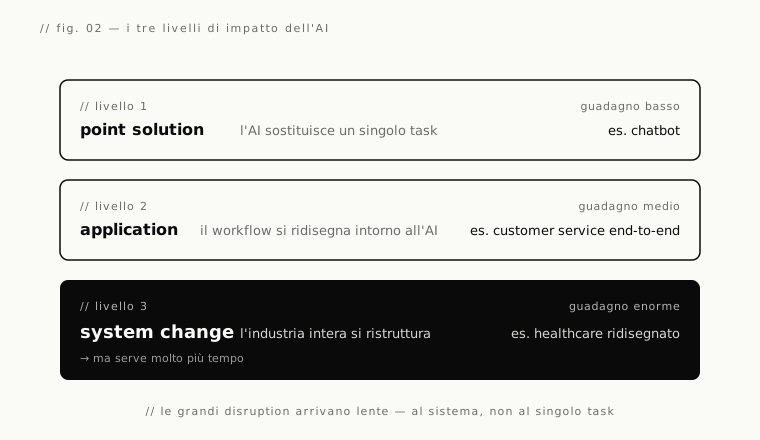
- Point solution. AI replaces a single task inside a process that stays the same. Example: a chatbot in place of the first level of customer service. Gain: limited, because the rest of the organization doesn't change.
- Application. The workflow gets redesigned around AI prediction. End-to-end customer service, where AI routes, answers, escalates, dashboards, all integrated. Gain: medium. You have to redesign processes.
- System change. The whole industry restructures because abundant prediction opens up business models previously impossible. Examples the book gives: insurance (individual dynamic pricing), healthcare (predictive diagnosis), advertising (per-user targeting). Gain: huge. Takes a lot more time.
3. Why big disruptions come slowly
This is where the book is most counter-intuitive. Everyone thinks AI will change everything in 5 years. The authors say: no, 20–30 years. Not because the technology isn't there — because system change requires that everything around it changes: rules, suppliers, contracts, pricing models, skills, laws.
The analogy is electricity. Invented at the end of the 1800s, but American factories really stopped running on steam only around 1920 — not for technical limits, but because buildings had to be redesigned. Steam factories had a central engine and belts everywhere; electric factories could have distributed motors. It's the architecture that had to change, not the motors.
4. The operational lesson
If you're a company today, the authors say: stop asking yourself "how do I use AI on my tasks?". Start asking yourself "which decision, that today we DON'T make because predicting it would cost too much, could we start making?". It's a mental inversion: you don't automate what you already do, you discover what you could do new.
Their example: an insurer today sells annual policies with fixed prices. Why? Because adjusting the price in real time would require too many predictions. When predictions cost nothing, the "annual policy" business model becomes arbitrary: you could have policies by kilometer, by week, by specific drive. That's system change.
5. What I take away
Three things:
- "Prediction vs judgment" is the most useful framing I've read on AI. It stops being magic and becomes an economic commodity.
- Point solutions aren't worth much. Everyone is rushing to build chatbots. The value sits in redesigning the workflow, not in glueing an LLM on top of the old one.
- Time is the underestimated factor. System changes come, but slowly. Whoever has studied the transition to electricity is clearer-eyed than those making hyper-optimistic predictions about 2030.
A personal note: this book helped me stop thinking of AI as "a new technology that gets added". It's more useful to think of it as a price change of an input — and reason about what that change enables.